What is a Stablecoin? How It Works and Its Benefits
What Are Stablecoins and How Do They Work?
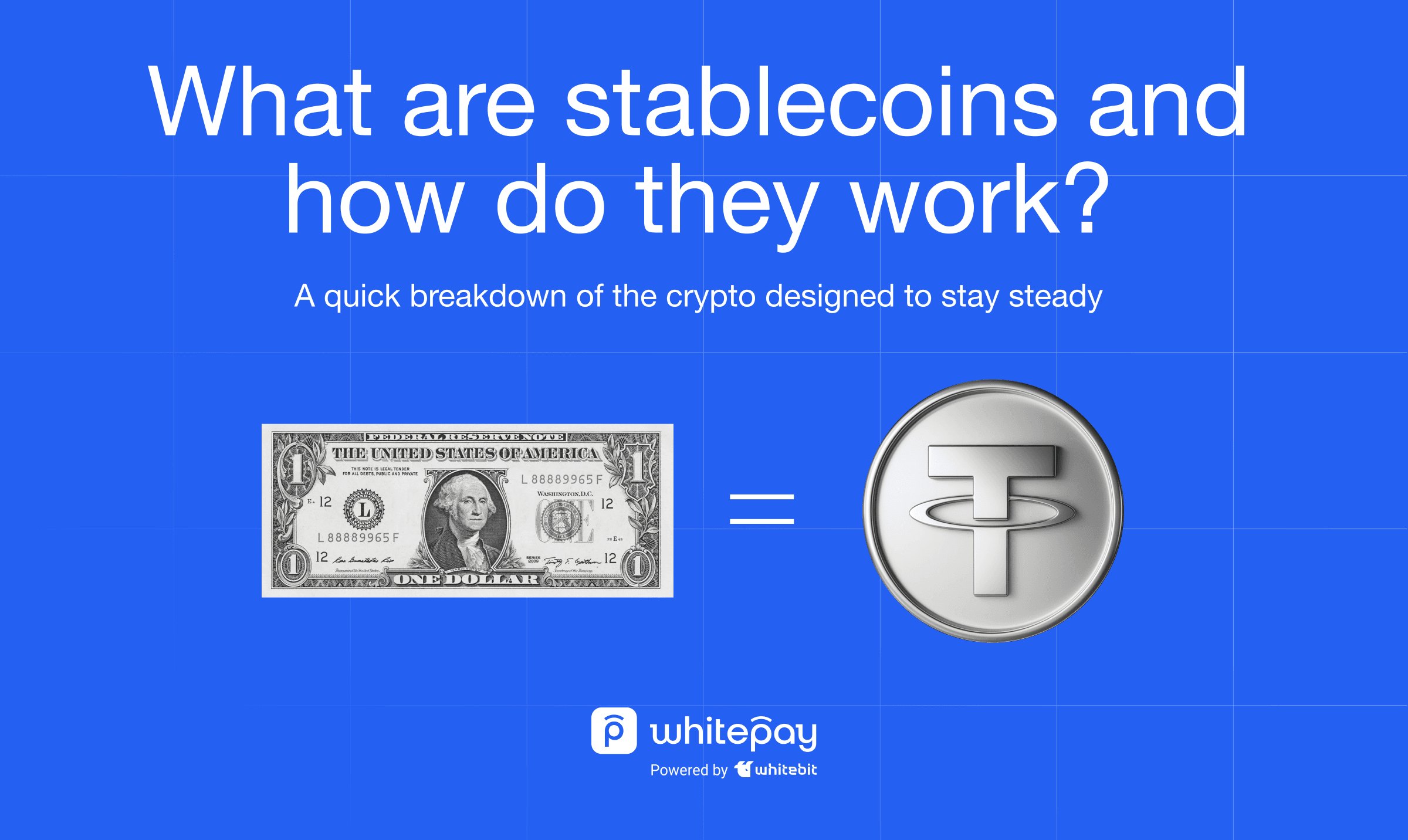
Stablecoins are digital tokens designed to hold a steady price, usually pegged to the US dollar or another asset. In most cases, 1 stablecoin = 1 dollar. But sometimes it’s not the case, and sometimes it is way more complicated. So, let’s break it down.
In this guide, we explain what are stablecoins, how stablecoins work, benefit of a stablecoin, the main types, risks, and simple ways to use them for payments and saving.
What Is a Stablecoin
A stablecoin is a type of cryptocurrency that aims to keep its value stable, unlike Bitcoin, Ethereum, and most other cryptocurrencies which often fluctuate. Most stablecoins are pegged to a fiat currency such as the US dollar, euro, or yen – meaning one token is designed to equal one unit of that currency. It has some advantages and some disadvantages from both crypto and fiat for those who need “something in between”.
They act as a bridge between traditional finance and crypto. Instead of dealing with volatile price swings, users can trade, send, and store digital assets while keeping predictable value. Three most popular examples are USDT, USDC, and DAI.
Stablecoins make it easier to move money across borders, pay online, and hold funds without converting back to fiat. In short, they bring stability to the fast-moving world of digital currency.
Why Are Stablecoins Important
Stablecoins make crypto practical. They let people send money, trade, and save without worrying about daily price swings. For traders, they offer a safe place to park funds between market moves. For businesses, they make it easy to accept crypto payments without volatility risk.
They also help with fast international transfers – often faster and cheaper than bank wires. In countries with unstable currencies, stablecoins like USDT act as digital dollars, giving users a way to protect value and pay online with confidence.
So, they are used not only by traders and crypto enthusiasts. They are convenient for lots of people. That’s why more and more businesses start to accept crypto payments.
How Do Stablecoins Maintain Their Value
Stablecoins keep a steady price by linking each token to assets or rules that hold the peg. The goal is simple:
1 token ≈ 1 unit of the reference asset (often $1, but can also be 1 EUR, 1 troy ounce of gold, etc).
Here are the main models. Different types of stablecoins have different value maintaining strategy.
Types of Stablecoins
Stablecoins vary in how they maintain value and the risks they carry. What are two types of stablecoins – basically there are fiat-backed and “others”.
Below are the main types with technical and investment angles. Types of stablecoins are at large part similar to their value maintaining process, but not entirely. To make it more clear, we will review different types of stablecoins from a technical and investment view.
Fiat-Collateralized Stablecoins
These stablecoins are backed 1:1 by fiat currency, such as the US dollar or euro. A company holds reserves of real money or cash-equivalent assets and issues tokens referencing those reserves. Two main examples are USDT and USDC. More than 95% of the stablecoins market is fiat-backed.
Technical view: Each stablecoin token corresponds to a fiat unit, and redemption mechanisms allow token-holders to exchange tokens for actual fiat.
Investment view: These are often seen as lower-risk among stablecoins because the backing is simpler to understand; investors judge the issuer’s transparency, reserve auditing, and regulatory compliance.
Commodity-Backed Stablecoins
These are less common and back tokens with tangible assets like gold, silver, or oil rather than fiat.
Technical view: The issuer holds physical commodities or commodity-linked assets in reserve and issues tokens that represent claim on those reserves.
Investment view: They provide an alternative to fiat-pegged coins and may appeal to those wanting assets less correlated with currencies – but due diligence is needed on custody and reserve audits.
Crypto-Collateralized Stablecoins
Tokens backed by other cryptocurrencies. Because crypto is volatile, these systems generally require over-collateralization (for example, $150 of ETH might back $100 worth of stablecoins). The only popular example is DAI.
Technical view: Smart contracts lock collateral and mint stablecoins; if the collateral falls in value, liquidation or margin triggers keep the peg.
Investment view: Offers decentralization and transparency, but carries risk of sharp crypto drops and liquidation events. Investors must monitor collateral health.
Algorithmic Stablecoins
These do not have full backing by reserves; instead they use supply-adjusting algorithms or protocol rules to stabilize price. Examples exist though some have failed.
Technical view: The protocol increases or decreases token supply, or uses dual-token mechanisms, to maintain the peg.
Investment view: High-risk, high-reward: if the mechanism holds, they can scale efficiently; if not, they may lose peg and collapse (as seen in past events). This type of coin is not popular, but can still be used.
Hybrid and Synthetic Models
Emerging stablecoins combine multiple backing methods: a mix of fiat, crypto, or algorithmic layers. These attempt to balance decentralization, stability, and efficiency.
Technical view: These systems may use part reserve, part algorithm, or part commodity to spread risk.
Investment view: They are newer / experimental; investors should check governance, reserve audits, and protocol rules closely.
Benefits of Stablecoins
Stablecoins make everyday money transfers fast and simple. They let people send and receive payments across countries in minutes, skipping banks and high fees. For freelancers, remote employees, and small exporters, it’s an easy way to get paid in dollars without opening a foreign account.
In many countries with unstable currencies, stablecoins like USDT or USDC work as digital dollars. People use them to store savings, pay rent, or buy goods online while avoiding inflation and currency restrictions.
Benefits of a Stablecoin for Business
Businesses also use stablecoins for quick settlements. Through platforms like Whitepay, they can receive crypto payments from anywhere in the world and instantly convert them into stable assets – keeping both speed and price stability.
Common Misconceptions About Stablecoins
What statement about stablecoins is true and what statement about stablecoins is not true? Try to guess before you read the right answer.
Opinion: Stablecoins are always stable and can’t lose their peg.
True: Their price depends on reserves and trust. If reserves are weak or markets panic, the peg can break.Opinion: All stablecoins are backed 1:1 with real dollars.
True: Some are, but most use a mix of assets like treasuries or crypto collateral, and some rely on algorithms instead of cash.Opinion: Stablecoins are fully anonymous.
True: Most transactions are public on the blockchain. Regulated issuers and payment processors use AML checks to trace activity. Moreover, some stablecoin operators, such as Tether, can sanction specific wallets following court orders. So, stablecoins are generally less anonymous than some other cryptocurrencies.Opinion: You can redeem any stablecoin instantly for cash.
True: Stablecoins are liquid, but redeeming options depend on your local laws. For example, in Ukraine you can do it easily using a currency exchange or crypto ATM. In the EU, you can also do it, but only after completing KYC verification.Opinion: Stablecoins are only useful for trading.
True: They’re used for saving, payments, and cross-border transfers – not just by traders, but also by everyday users and businesses. They are indeed very useful for international transfers (especially from and to countries with closed, slow, or overregulated banking systems).
Regulatory Oversight and Legal Status
Stablecoins have moved from the margins of crypto into the center of financial regulation. They now process hundreds of billions of dollars each month – and regulators around the world are closing the gap between crypto and traditional finance. While details differ, all major frameworks focus on the same goals: full reserve backing, redemption at par value, and strong anti–money laundering compliance.
Global financial bodies like the Financial Stability Board (FSB) and Bank for International Settlements (BIS) have set the tone with the principle “same activity, same risk, same rules.” This means stablecoins that function like money must meet the same transparency, liquidity, and reporting standards as banks and e-money providers. The FSB defines large cross-border stablecoins as global stablecoins (GSCs), requiring them to maintain clear redemption rights and cooperate with multiple jurisdictions for oversight.
Across Leading Regions
United States: The GENIUS Act of 2025 introduced the first federal framework for “payment stablecoins.” Both banks and licensed fintech firms can issue them, provided they keep 1:1 reserves in USD cash or short-term Treasuries. The law separates payment stablecoins from securities and commodities, ending the long dispute between the SEC and CFTC. It also makes AML rules mandatory for every issuer.
European Union: Under MiCA, stablecoins are divided into E-Money Tokens (EMTs) pegged to one currency, and Asset-Referenced Tokens (ARTs) pegged to several. Issuers must be licensed in the EU, hold segregated reserves, publish detailed white papers, and allow redemption at face value. Tokens not tied to the euro face transaction limits to protect monetary sovereignty.
Ukraine: Aligning its crypto laws with the EU’s MiCA. A 2025 draft bill defines stablecoins as regulated virtual assets, requiring licensed issuers, full reserves, and AML controls. Algorithmic coins are restricted. Individuals must declare crypto income, while businesses gain legal clarity to use stablecoins for payments under transparent taxation and supervision.
Singapore: The Monetary Authority of Singapore allows only single-currency stablecoins pegged to the Singapore dollar or major global currencies. Each must be 100% backed by cash or short-term government debt, verified monthly, and redeemable at par within five business days.
United Arab Emirates: The UAE’s system is split among VARA (Dubai), CBUAE, and ADGM, each offering licensing for fiat-backed stablecoins only. Algorithmic tokens are banned.
Hong Kong: The Stablecoins Ordinance of 2025 requires issuers to hold HKD 25 million in capital and maintain full reserve backing in segregated custody. The HKMA runs a sandbox to help issuers transition to the new licensing system.
In all cases, the key principles remain the same: transparency of reserves, reliable redemption, and strict AML/CFT control. Global regulators want to prevent “run risk” (mass redemptions) and illicit finance while giving legitimate issuers a path to operate safely.
At Whitepay, compliance follows the same international logic. Powered by WhiteBIT, the platform holds registrations in Lithuania, Spain, Poland, the Czech Republic, Bulgaria, and Australia. It complies with FATF, GDPR, PCI DSS, and ISO/IEC 27001 standards – making it one of the few crypto payment providers operating under full legal oversight and verified by Chainalysis for AML protection.
The Role of Stablecoins in the Crypto Ecosystem
Stablecoins act as the bridge between traditional finance and digital assets. They let traders move money between exchanges without banks, keep funds stable during volatility, and serve as the main currency for crypto payments and DeFi. Their steady value makes them essential for liquidity, settlements, and everyday use in the digital economy.
How to Use Stablecoins in Practice
You can hold stablecoins to protect value, pay online or in stores, send money abroad, or trade other cryptocurrencies. Businesses can accept them easily with crypto payments tools like Whitepay, which convert and process stablecoin transactions quickly and securely.
Conclusions
Now you know what a stablecoin is. It combines the flexibility of cryptocurrencies with the reliability of traditional money. They reduce volatility, simplify global transactions, and make crypto payments practical for daily use. Whether for trading, savings, or business settlements, stablecoins are becoming a key part of modern finance.
Understanding what a stablecoin is and how it works helps investors and companies use digital currencies safely and efficiently.
FAQ
We have collected the most popular questions about our crypto acquiring solution. If you didn’t find the answer, contact support@whitepay.com, and we will help you!